Define the interval
Operating temperatures, allowed movement and any required coefficient-of-expansion acceptance limits.

Controlled-expansion alloy tubing
Low-expansion alloy. Drawing-defined geometry. Custom Invar 36 capillary tubes for electronic assemblies and precision instruments.
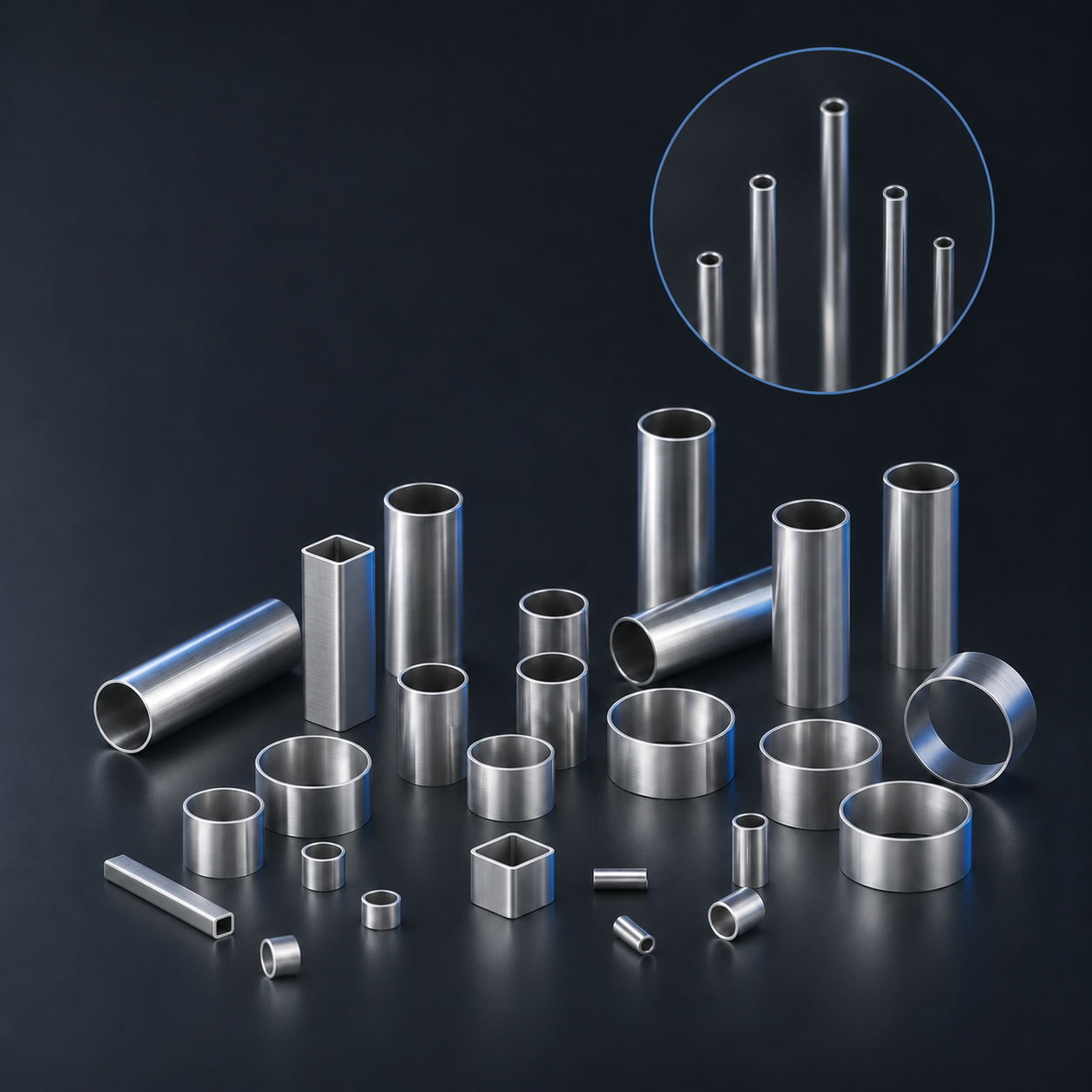
*Company-wide manufacturing capability, not a guaranteed range for every Invar 36 tube. Dimensions and tolerances are confirmed against the complete drawing and material requirements.
Dimensional stability starts here
Invar 36 is an iron–nickel alloy with nominally 36% nickel, selected to limit dimensional change as temperature varies.
Its low-expansion behavior depends on the temperature interval and material condition. Cold work and subsequent heat treatment also matter to dimensional stability.
Iron balance · minor elements controlled by the agreed material specification.
Provide the working temperature interval, allowable dimensional change and any required expansion test. We review these alongside tube dimensions, supply condition and certificate requirements.
Define the complete part
A low-expansion alloy is only one part of a precision assembly. ID, OD, wall thickness, length and end requirements must work together with the specified material condition.
Our technical specialists bring more than 20 years of industry experience to the review of custom tube and micro-component requirements.
Operating temperatures, allowed movement and any required coefficient-of-expansion acceptance limits.
Grade, material standard and heat-treatment requirements, including any subsequent customer processing.
ID, OD, wall, length and tolerances assessed together before confirming manufacturability.
Define the critical dimensions and inspection requirements. No fixed wall ratio or standard tube geometry is assumed.
Send your requirements →*Invar 36 feasibility depends on grade, material condition, diameter, wall, length and inspection criteria. A specific size or tolerance is confirmed during quotation, not implied by the overall capability range.
MingQuan uses cold rolling, cold drawing, bright annealing and leak-tightness testing to produce long tubes with close control of internal and external dimensions. CNC cutting and precision polishing then turn the tubes into short components.
Long tubes have smooth inner and outer surfaces free from oxide scale. Cut components have burr-free openings and no obvious surface damage under 20× magnification.
This manufacturing scope is shared across our product range. The production route, achievable size combination, surface finish and inspection requirements are confirmed for the selected material and drawing. The typical ±0.1 mm length tolerance applies to cut short parts; it is not an ID / OD tolerance. Leak-test method, coverage and acceptance criteria are agreed for the tube. Tube testing does not by itself qualify a completed sealed assembly.
Electronics & precision instruments
Invar 36 tubes, sleeves and short tube components for semiconductor and integrated-circuit packaging designs where temperature-related dimensional change is a design constraint.
Explore custom tubing for optical and precision-instrument designs where maintaining relative component positions is important.
These are design contexts, not pre-qualified parts. Final suitability depends on the assembly, environment and customer validation requirements.
Requirements into records
Agreed alloy designation and material documentation linked to the production requirement.
Critical dimensions, tolerance definitions and acceptance criteria established from the drawing.
Material identification and traceability maintained throughout production.
ISO 9001 and ISO 13485 quality management systems, with controls matched to the application.
Before you specify
No. Invar 36 is an iron–nickel alloy selected for low thermal expansion. Pure nickel is a separate material family. Explore our pure nickel capillary tubes for that material route.
No. Expansion varies with temperature and material condition. Specify the required temperature interval and acceptance limits rather than assuming zero movement.
No. This ID / OD tolerance is available on selected capillary sizes only. The complete Invar 36 drawing, material condition and inspection requirements must be reviewed before any tolerance is confirmed.
Send the material specification, ID, OD, wall, length, tolerances, quantity and operating temperature interval. Include any heat-treatment, expansion-test or certificate requirements.
Your Invar 36 tube project
A drawing starts the conversation. Your thermal and material requirements help us review the complete part.