SUS 304
General-purpose austenitic stainless
A broadly specified chromium–nickel stainless grade for precision tube programs requiring a practical balance of corrosion resistance, formability and manufacturability.

Austenitic stainless capillary tubing
Custom stainless steel capillary tubes developed around your drawing, selected grade and end-use requirements.
Select the material route
SUS 304, SUS 304L and 304V belong to the austenitic stainless steel family, but they should not be treated as interchangeable labels. Material selection is based on the drawing, processing route, application environment and the governing customer specification.
MingQuan confirms the exact material designation and certificate requirements before production.
A broadly specified chromium–nickel stainless grade for precision tube programs requiring a practical balance of corrosion resistance, formability and manufacturability.
The low-carbon alternative is selected when the drawing, joining process or application standard specifically requires 304L material.
Used where a customer or mill specification calls for vacuum-remelted 304 material and more uniform chemistry. The applicable melt route and certificate must be confirmed for each program.
“304V” is not presented as a universal JIS equivalence on this page. Vacuum-remelted designations and acceptance criteria can vary by material supplier, so MingQuan works from the customer’s material specification or approved mill certificate.
Geometry and grade together
The same alloy can behave differently as diameter, wall thickness, reduction route and end condition change. We review the complete specification before confirming tolerances and production feasibility.
Tolerance capability depends on the complete material–diameter–wall–length combination. Submit a drawing for engineering confirmation.
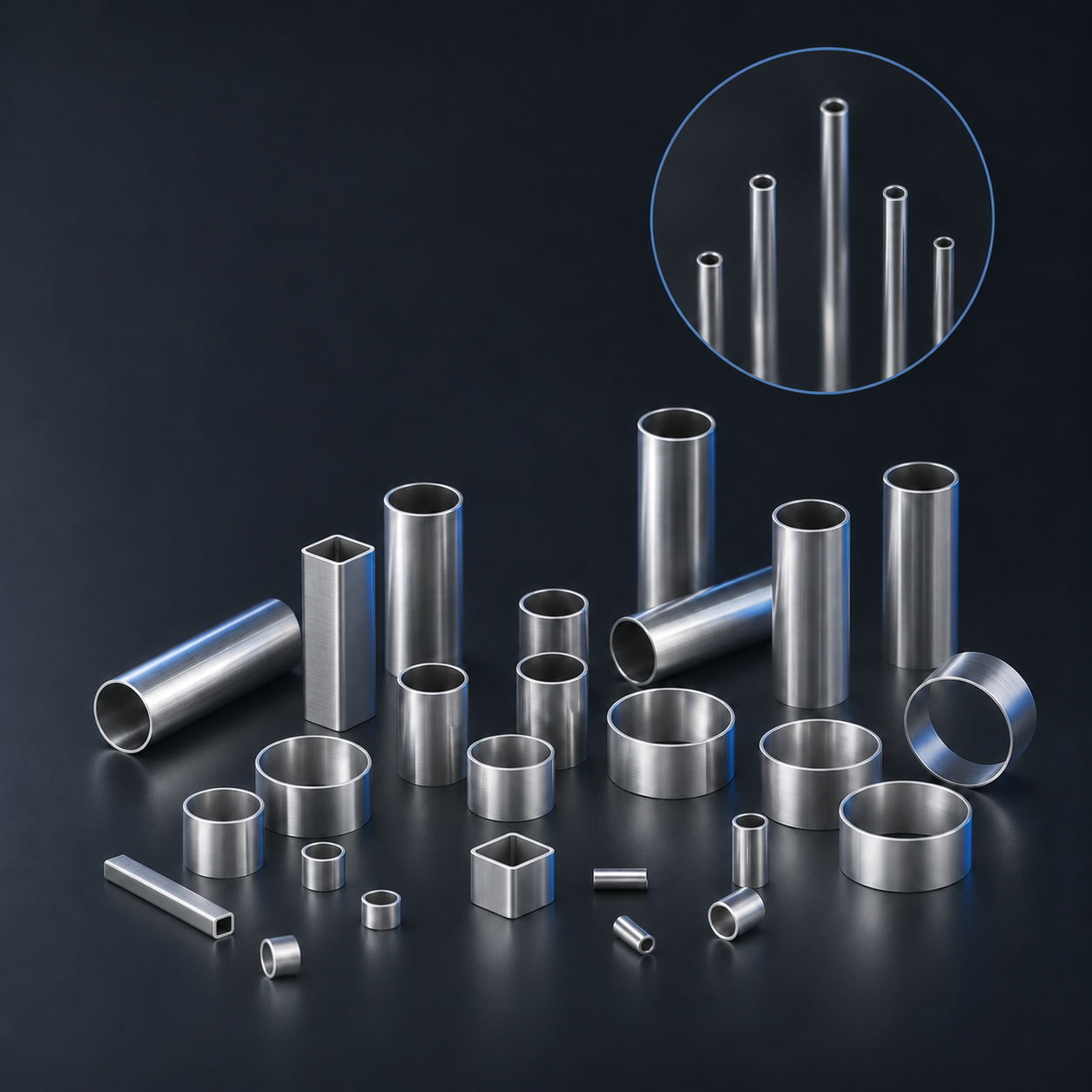
MingQuan uses cold rolling, cold drawing, bright annealing and leak-tightness testing to produce long tubes with close control of internal and external dimensions. CNC cutting and precision polishing then turn the tubes into short components.
Long tubes have smooth inner and outer surfaces free from oxide scale. Cut components have burr-free openings and no obvious surface damage under 20× magnification.
This manufacturing scope is shared across our product range. The production route, achievable size combination, surface finish and inspection requirements are confirmed for the selected material and drawing. The typical ±0.1 mm length tolerance applies to cut short parts; it is not an ID / OD tolerance. Leak-test method, coverage and acceptance criteria are agreed for the tube. Tube testing does not by itself qualify a completed sealed assembly.
Application-led selection
For medical tube programs, MingQuan selects SUS 304L raw material against the component specification. Precision dimensions and fine inner and outer finishes support catheter assemblies, endoscopic components and other custom tube-based parts.
Custom stainless capillary tubes for sensors, precision interfaces, small mechanical assemblies and R&D components manufactured to customer drawings.
High dimensional precision, smooth surfaces and an oxide-scale-free finish for SUS 304L medical tubing. Surface and processing requirements are confirmed with the complete component drawing.
Processes can be coordinated to customer requirements; the scope and sequence are agreed for each project. The coordinated medical-component services described here are reviewed for SUS 304L programs. Corrosion resistance and biocompatibility must be assessed for the finished component and intended device; cleaning and packaging do not imply sterile supply.
Confirm before production
Material designation and governing customer specification reviewed before manufacture.
Strict identification and traceability controls throughout production.
Applicable national, industry, enterprise and customer requirements are combined for each program.
ISO 9001 and ISO 13485 quality management systems.
Stainless tube inquiry
Send the drawing, required 304-series designation, material certificate requirements and expected quantity for feasibility review.