Define the condition
Confirm the material specification, required supply condition and mechanical acceptance criteria.

Cobalt alloy tubing
Custom cobalt–nickel alloy capillary tubes for demanding medical and specialty components. Material condition and precise geometry, developed around your drawing.
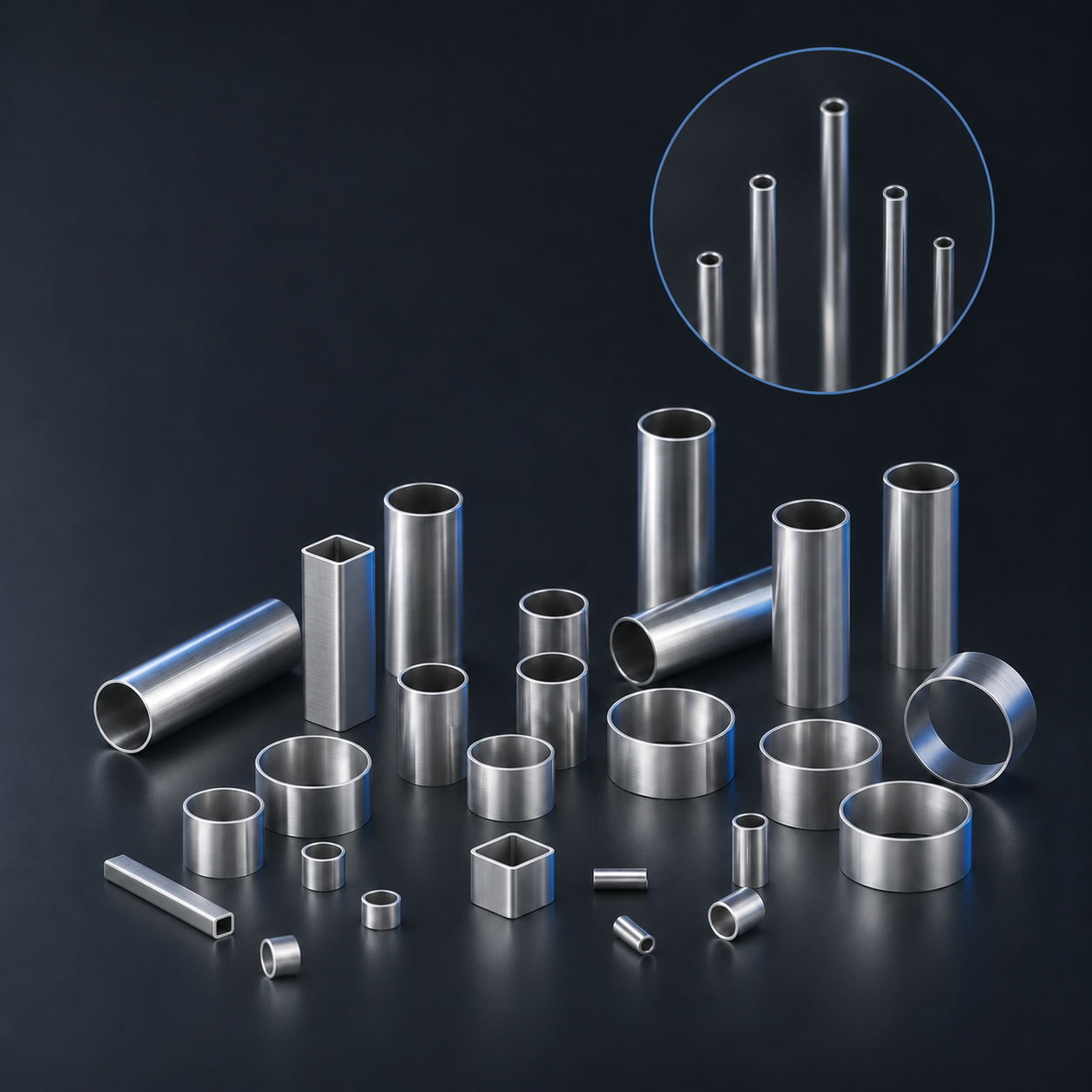
*Company-wide manufacturing capability, not a guaranteed range for every MP35N tube. Dimensions and tolerances are confirmed against the complete drawing and material requirements.
Strength starts with condition
MP35N® is a cobalt–nickel–chromium–molybdenum alloy, identified as UNS R30035. It is selected for applications that call for high strength and corrosion resistance.
Cold working and aging influence its mechanical properties. A tube specification should therefore define the required supply condition as well as its dimensions.
Co–Ni–Cr–Mo alloy · UNS R30035
Composition limits follow the agreed material specification.
Tell us whether the tube will be formed, joined or processed further. Include strength, elongation or hardness requirements where relevant, with the test method and acceptance limits.
The alloy name alone does not guarantee a tensile strength or a finished-device performance level. Required properties and their verification must be agreed for the specified tube.
From alloy to finished geometry
MingQuan develops MP35N capillary tubes and tube-based components from customer drawings. ID, OD, wall thickness, length, end geometry and material condition are reviewed together.
Our technical specialists bring more than 20 years of industry experience, with core production expertise in ultra-fine tubing below 6 mm.
Confirm the material specification, required supply condition and mechanical acceptance criteria.
Specify ID, OD, wall, length and critical tolerances as one manufacturable combination.
Identify mating parts, end requirements and any subsequent forming, joining or finishing operations.
Tube lengths, sleeves and related micro-components are reviewed against the drawing. Bore size and wall thickness are defined by your design, not by a fixed standard ratio.
Send your requirements →*MP35N feasibility depends on material condition, diameter, wall, length and inspection criteria. A specific size, tolerance or mechanical property is confirmed during quotation, not implied by the overall capability range.
MingQuan uses cold rolling, cold drawing, bright annealing and leak-tightness testing to produce long tubes with close control of internal and external dimensions. CNC cutting and precision polishing then turn the tubes into short components.
Long tubes have smooth inner and outer surfaces free from oxide scale. Cut components have burr-free openings and no obvious surface damage under 20× magnification.
This manufacturing scope is shared across our product range. The production route, achievable size combination, surface finish and inspection requirements are confirmed for the selected material and drawing. The typical ±0.1 mm length tolerance applies to cut short parts; it is not an ID / OD tolerance. Leak-test method, coverage and acceptance criteria are agreed for the tube. Tube testing does not by itself qualify a completed sealed assembly.
Medical & specialty components
Discuss MP35N tube sections and micro-components for catheter, delivery-system and other medical device designs that specify this alloy.
Drawing-based tubing and sleeves for precision assemblies where the design calls for a high-strength, corrosion-resistant alloy.
Alloy selection and tube supply do not establish biocompatibility, sterility or regulatory approval for a finished medical device. The device manufacturer must evaluate the completed product for its intended use.
Defined before production
Alloy designation, customer specification and supply condition established before production.
Critical dimensions, tolerance definitions and inspection requirements taken from the drawing.
Material identification and traceability maintained throughout production, with documentation requirements agreed at quotation.
ISO 9001 and ISO 13485 quality management systems, with controls matched to the application.
Before you specify
No. MP35N is a cobalt–nickel–chromium–molybdenum alloy, not an iron-based stainless steel. It should be specified separately from grades such as SUS 304 or SUS 316L.
No. Mechanical properties depend on the processing and supply condition. State the required properties and acceptance tests; values for another product form or condition should not be used as a tube guarantee.
We review tube supply against the agreed component specification. Cleaning, subsequent processing and finished-device qualification must be defined by the customer. Tube supply alone does not mean the part is sterile or approved for implantation.
No. This ID / OD tolerance is available on selected capillary sizes only. The complete geometry, material condition and inspection requirements must be reviewed before a tolerance is confirmed.
Your MP35N tube project
Send the part geometry, material requirements and intended application. We will review the details together before confirming the supply scope.